
Digital library
Showing results 1 - 12/25
Providing knowledge, upholding regulations, creating awareness (Parc naziunal Svizzer)
The presentation on the Swiss National Park, classified as IUCN Category Ia – Strict Nature Reserve, highlighted the management of one of the most strictly protected areas in Europe. The park is based on clear legislation, strict rules, and the principle of minimal human interference in natural processes. Visitors must stay on marked trails, while activities such as collecting natural materials, camping, or flying drones are prohibited.
The lecture emphasized the importance of combining digital and personal visitor information, including websites, apps, social media, visitor centers, and direct contact with park rangers. Visitor counters and trail monitoring help track visitor pressure within the park.
Strong supervision and consistent enforcement are key elements of management. Rangers conduct regular patrols and use digital systems to issue fines for violations, ensuring that visitors understand and respect the park’s strict conservation regime.
Source
Other
Year
2026
Type
Published scientific paper at the conference
Format
Document (PDF, DOC, ...)
Author
Claudia Gerber
Keywords
Swiss National Park, IUCN Category Ia (Strict Nature Reserve), strict protection regime, monitoring, information, visitor counters
Območja
Alps
Visitor Numbers in Haute-Savoie Nature Reserves: Examples of communication, management, and regulation
The speakers presented the management of the Haute-Savoie nature reserves in France, where visitor management measures strongly adapt to seasonal conditions. In winter, the focus is on establishing and respecting quiet zones to protect wildlife, as animals are particularly vulnerable due to low temperatures and limited food. Communication campaigns and video content help visitors understand the importance of responsible behaviour in these sensitive areas.
In summer, the main challenges are traffic pressure and bivouacking. To address this, reservation systems for camping, limits on the number of tents, and increased on-site supervision have been introduced in the most visited areas.
The speakers emphasized that management relies on a combination of legislation, supervision, and targeted communication, with the main goal of preventing conflicts and reducing pressure on sensitive locations.
Source
Other
Year
2026
Type
Published scientific paper at the conference
Format
Document (PDF, DOC, ...)
Authors
Laurent Delomez, Geoffrey Garcel
Keywords
Haute-Savoie Nature Reserves (France), quiet zones, bivouacking, reservation system, seasonal management, monitoring, communication
Območja
Alps
A Visible Bestiary - Handbook to the Visitors of our mountains (Aree Protette Alpi Marittime - Italy)
The authors presented an original and somewhat humorous approach to understanding modern mountain visitors, using the Italian Alpi Marittime Park as an example. They described different visitor profiles, ranging from ski tourers and cyclists to drone users, social media influencers, and hikers with dogs.
They also highlighted the rapidly increasing number of visitors in the Alpine region and the influence of social media, which can direct visitor flows into sensitive natural areas.
The park therefore combines awareness-raising, educational campaigns, clear communication of rules, and, when necessary, supervision and enforcement, using creative approaches to reach different groups of visitors.
Source
Other
Year
2026
Type
Published scientific paper at the conference
Format
Document (PDF, DOC, ...)
Authors
Irene Borgna, Costanza Luconi
Keywords
Alpi Marittime protected area (Italy), visitor profiles, social media, awareness raising, regulation, biodiversity
Link
Območja
Alps
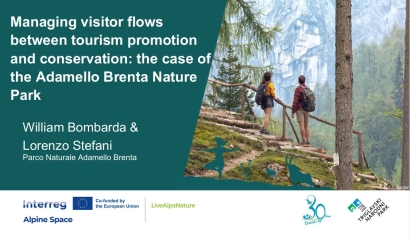
Managing visitor flows between tourism promotion and conservation: the case of the Adamello Brenta Nature Park IItaly)
The speakers presented visitor management in Adamello Brenta Nature Park (Italy). A key challenge is balancing tourism development with the protection of sensitive natural areas.
The park applies several visitor management measures, including regulated access to valleys through controlled parking and paid entry, shuttle transport to reduce traffic, and a network of trail sensors that monitor visitor numbers in real time. The collected data serve as an early warning system for spatial pressure and support the adjustment of management measures.
The goal of management is not only to reduce the number of visitors, but above all to direct visitor flows to more resilient areas while protecting the most vulnerable parts of the park.
Source
Other
Year
2026
Type
Published scientific paper at the conference
Format
Document (PDF, DOC, ...)
Authors
William Bombarda, Lorenzo Stefani
Keywords
Adamello Brenta Nature Park (Italy), carrying capacity, visitor redistribution, sustainable tourism, monitoring, nature conservation
Območja
Alps
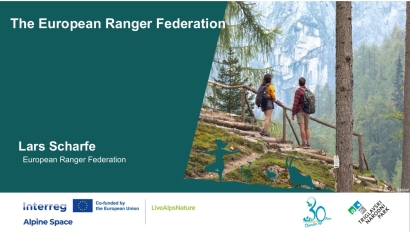
The European Ranger Federation
The presentation provided a broader overview of the European Ranger Federation (ERF), which connects rangers and nature conservation organizations across Europe. The network aims to strengthen professional knowledge, international cooperation, and the professionalization of the ranger profession.
ERF carries out training activities, working groups, and international projects addressing topics such as conflict management, the use of new technologies, and the exchange of good practices. Special attention is also given to strengthening the role of women in the ranger profession and supporting younger generations of professionals.
The presentation emphasized that today’s conservation challenges go beyond national borders, making international cooperation, knowledge exchange, and shared standards essential for effective management of protected areas.
Source
Other
Year
2026
Type
Published scientific paper at the conference
Format
Document (PDF, DOC, ...)
Author
Lars Scharfe
Keywords
European Ranger Federation, networking, training, international cooperation, women rangers, working groups, professionalization
Območja
Alps
Andrej Zdravič: SECRETS OF SOČA – Time Horizon (Trailer)
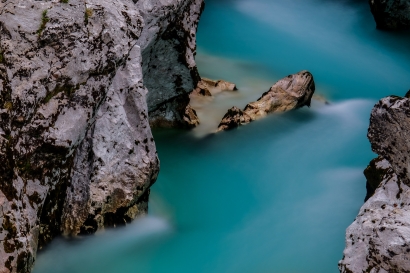
Andrej Zdravič is an award-winning filmmaker who has immersed himself in underwater filming of the Soča River, an important natural treasure of Triglav National Park. His half-hour video and sound installation Secrets of Soča is on view at the TNP Info Center Dom Trenta. The trailer you are about to watch offers only a glimpse of this unique installation.
“My first attempts at underwater filming of the Soča River in 1987 inspired me to develop a special device that allowed me to reveal visual perspectives of the Soča previously unknown to the human eye,” Andrej Zdravič wrote about the permanent video installation, originally created in 1995 and, more than three decades later, presented in a renewed form at the TNP Info Center Dom Trenta.
The filmmaker captured the Soča in a unique way throughout all seasons of the year. The video installation thus becomes “a wreath of songs of the Soča River. Each song reveals, through image and sound, one of the many states of life arising from the movement and phenomena of the river’s waters: Mysterious Source, Light Rays, Undulations, Black Water, Droplets of Snow, Summer Forest, Little Cascade, Air Manes, Secret Pulse, Trout Games, Dance of Pebbles, Chalk, Little Beach, Water Sky, Liquid Glass, Funnels, Swift Current, Spaces, Guardian of the Deep, Stormy Stream, Autumn, Leaves and Rain, Swarm of Light, The Source, Mount Triglav.”
Secrets of Soča installation unfolds before visitors to The TNP Info Center Dom Trenta across multiple television screens. Conceptually, the program is based on the Time Horizon concept, first realized by Andrej Zdravič in 1993 in the installation Water Waves for the Exploratorium, a museum of science, tehnology, and art in San Francisco.
A few words about the author: In 1999, Andrej Zdravič received the Prešeren Fund Award. Two decades later, he was honored with the Badjura Award for Lifetime Achievement. Over the course of his creative career, Andrej Zdravič has produced nearly 40 films and video installations, including the one that reveals to visitors of TNP Info Center Dom Trenta a previously unseen, hidden underwater world of the emerald river.
Source
You Tube, Triglavski narodni park
Year
2025
Type
Video clip
Format
Video
Author
Andrej Zdravič
Keywords
Triglavski narodni park, Triglav National Park, Soča, Soca River, Trenta, Slovenija, Slovenia
Območja
Triglav National Park, Alps, Slovenia
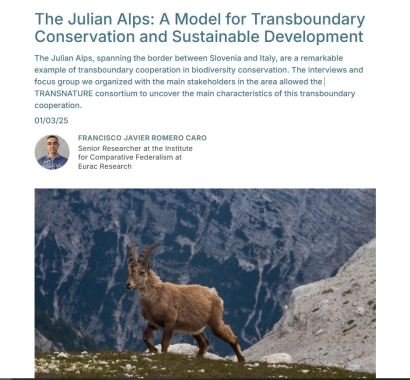
The Julian Alps: A Model for Transboundary Conservation and Sustainable Development
The Julian Alps, spanning the border between Slovenia and Italy, are a remarkable example of transboundary cooperation in biodiversity conservation. The interviews and focus group we organized with the main stakeholders in the area allowed the TRANSNATURE consortium to uncover the main characteristics of this transboundary cooperation.
Source
Other
Year
2025
Type
News
Format
Website
Author
Francisco Javier Romero Caro
Keywords
Julian Alps, Biosphere Reserve, transboundary
Območja
Triglav National Park, Alps
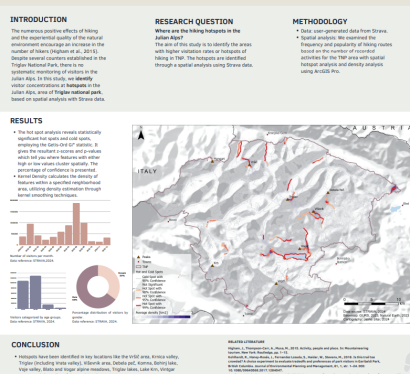
Footprints in the Julian Alps: Identifying Hiking Hotspots
The numerous positive effects of hiking and the experiential quality of the natural environment encourage an increase in the number of hikers. Despite several counters established in the Triglav National Park, there is no systematic monitoring of visitors in the Julian Alps. In this study, we identify visitor concentrations at hotspots in the Julian Alps, area of Triglav national park,based on spatial analysis with Strava data.
Source
ResearchGate, Filozofska fakulteta
Year
2024
Type
Poster
Format
Website
Author
Jasna Sitar
Keywords
Hiking hotspots, Strava data, Julian Alps, Triglav national park
Območja
Triglav National Park, Alps
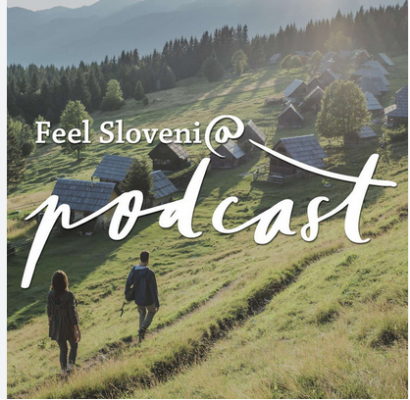
Exploring Triglav National Park: Stories of Summiting Slovenia's Iconic Peak and the Splendour of the Park
This time, Feel Slovenia the Podcast explores Triglav National Park, Slovenia's only national park. The episode celebrates the park's 100th anniversary, highlighting its significance as a protected landscape under UNESCO. The focus is on responsible and sustainable tourism, with emphasis on Mount Triglav, Slovenia's highest peak. Various guests share their experiences and insights, including climbers, comedians, authors, and tourism directors, discussing the symbolism of Triglav and the park's trails. With laughter, awe, and wisdom, the episode promotes mutual respect between tourists and locals, emphasizing the park's role in balancing nature conservation and tourism.
Source
FEEL Slovenia Podcast
Year
2024
Type
Podcast
Format
Audio
Keywords
Triglav national park, responsible and sustainable tourism, Triglav
Območja
Triglav National Park, Alps, Slovenia
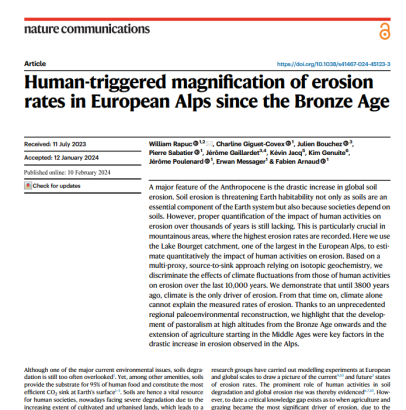
Human-triggered magnification of erosion rates in European Alps since the Bronze Age
A major feature of the Anthropocene is the drastic increase in global soil erosion. Soil erosion is threatening Earth habitability not only as soils are an essential component of the Earth system but also because societies depend on soils. However, proper quantification of the impact of human activities on erosion over thousands of years is still lacking. This is particularly crucial in
mountainous areas, where the highest erosion rates are recorded. Here we use the Lake Bourget catchment, one of the largest in the European Alps, to estimate quantitatively the impact of human activities on erosion. Based on a multi-proxy, source-to-sink approach relying on isotopic geochemistry, we discriminate the effects of climate fluctuations from those of human activities
on erosion over the last 10,000 years. We demonstrate that until 3800 years ago, climate is the only driver of erosion. From that time on, climate alone cannot explain the measured rates of erosion. Thanks to an unprecedented regional paleoenvironmental reconstruction, we highlight that the development of pastoralism at high altitudes from the Bronze Age onwards and the extension of agriculture starting in the Middle Ages were key factors in the drastic increase in erosion observed in the Alps.
Source
ResearchGate
Year
2024
Type
Research
Format
Website
Authors
William Rapuc, Charline Giguet-Covex, Julien Bouchez, Pierre Sabatier, Jérôme Gaillardet, Kévin Jacq, KIm Genuite, Jérôme Poulenard, Erwan Messager, Fabien Arnaud
Keywords
Erosion, climate, soil, human activities
Območja
Alps
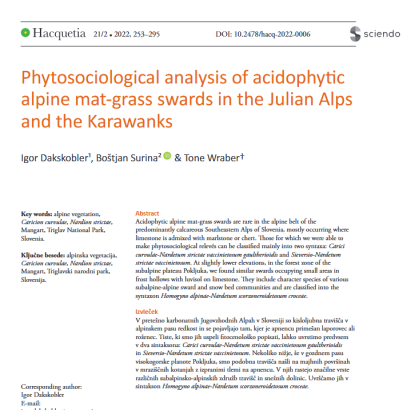
Phytosociological analysis of acidophytic alpine mat-grass swards in the Julian Alps and the Karawanks
Acidophytic alpine mat-grass swards are rare in the alpine belt of the predominantly calcareous Southeastern Alps of Slovenia, mostly occurring where limestone is admixed with marlstone or chert. Those for which we were able to make phytosociological relevés can be classified mainly into two syntaxa: Carici curvulae-Nardetum strictae vaccinietosum gaultherioidis and Sieversio-Nardetum strictae vaccinietosum. At slightly lower elevations, in the forest zone of the subalpine plateau Pokljuka, we found similar swards occupying small areas in frost hollows with luvisol on limestone. They include character species of various subalpine-alpine sward and snow bed communities and are classified into the syntaxon Homogyno alpinae-Nardetum scorzoneroidetosum croceae.
Source
Digitalna knjižnica Slovenije, ZRC SAZU, Biološki inštitut Jovana Hadžija
Year
2022
Type
Thesis
Format
Website
Authors
Igor Dakskober, Boštjan Surina, Tone Weber
Keywords
Alpine vegetation, Caricion curvulae, Nardion strictae, Mangart, Triglav National Park, Slovenia
Območja
Triglav National Park, Alps, Slovenia
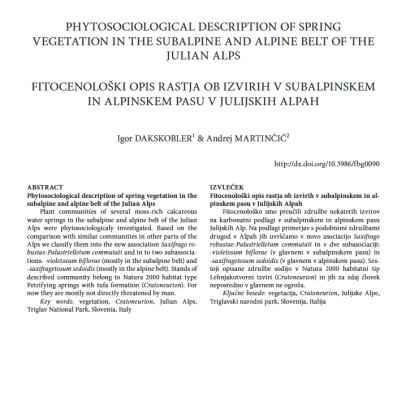
Phytosociological description of spring vegetation in the subalpine and alpine belt of the Julian Alps
Plant communities of several moss-rich calcareous water springs in the subalpine and alpine belt of the Julian Alps were phytosociologicaly investigated. Based on the comparison with similar communities in other parts of the Alps we classify them into the new association Saxifrago robustae-Palustrielletum commutati and in to two subassociations: -violetosum biflorae (mostly in the subalpine belt) and -saxifragetosum sedoidis (mostly in the alpine belt). Stands of described community belong to Natura 2000 habitat type Petrifying springs with tufa formation (Cratoneurion). For
now they are mostly not directly threatened by man.
Source
Digitalna knjižnica Slovenije, Slovenska akademija znanosti in umetnosti
Year
2022
Type
Thesis
Format
Website
Authors
Igor Dakskobler, Andrej Martinčič, Andreja Šalamon
Keywords
Vegetation, Cratoneurion, Julian Alps, Triglav National Park, Slovenia, Italy
Območja
Triglav National Park, Alps
Was this page helpful?
Thank you
Thank you.