
Digital library
Showing results 12 - 24/25
Phytosociological analysis of Carex bicolor All. sites in the Julian Alps
We conducted a phytosociological investigation of the sites of Carex bicolor on the only known localities of this species in the Julian Alps, in the upper part of the Triglav Lakes Valley. Carex bicolor was recorded in different alpine communities, most of which belong to the class Scheuchzerio-Caricetea fuscae and order Caricetalia davallianae. We described a new association Caricetum bicolori-frigidae, which is classified into the alliance Caricion atrofusco-saxatilis and is for now the only community of this alliance in Slovenia.
Source
Digitalna knjižnica Slovenije, Slovenska akademija znanosti in umetnosti
Year
2022
Type
Thesis
Format
Website
Authors
Igor Dakskobler, Andrej Martinčič, Andreja Šalamon
Keywords
Vegetation, alpine lake, snow beds, Triglav National Park, Slovenia
Območja
Triglav National Park, Alps
New localities of Adiantum capillus-veneris and Moehringia villosa in the southern Julian Alps
The article describes new localities of two rare species
of conservation importance of Slovenian flora in the southern julian alps (the tolmin-bohinj and Krn Mts.). The stands of the Mediterranean species Adiantum capillus-veneris in Kneška grapa gorge under Mt. Masovnik (Kneške Ravne) at elevations 570–600 m are assigned to the new variant Eucladio-Adiantetum hymenostylietosum recurvirostri var. Astrantia carniolica. Moehringia villosa, an endemic species of european conservation importance, has its north- westernmost locality in its entire distribution range at curk waterfall in the spring area of the Kozjak under Mt. Krnčica,
where it occurs in the stands of the variant Campanulo carnicae-Moehringietum villosae var. Paederota lutea.
Source
Digitalna knjižnica Slovenije, Slovenska akademija znanosti in umetnosti
Year
2021
Type
Original scientific article
Format
Website
Authors
Igor Dakskobler, Andrej Martinčič, Andreja Šalamon
Keywords
Flora, vegetation, Adiantum capillus-veneris, Moehringia villosa, natura 2000, triglav national park, Slovenia
Območja
Triglav National Park, Alps
Vegetation analysis of the subalpine beech forest on the upper forest line in the Julian Alps (NW Slovenia and NW Italy) and in the northern Dinaric Alps
Using hierarchical clustering with unweighted pair-group method with arithmetic mean (UPGMA) we arranged 603 phytosociological relevés of beech forests on the present upper forest line, mainly from the Julian Alps and the Trnovo Forest Plateau (we also included the relevés from the Karawanks and the Kamnik Alps), into 32 clusters. Based on their analysis and comparison with previously described similar (alti)montane-subalpine beech communities we classified most of the relevés into the association Polysticho lonchitis-Fagetum and its new subassociations ericetosum carneae, cardaminetosum trifoliae, luzuletosum niveae, luzuletosum luzuloidis, calamagrostietosum variae, allietosum victorialis, adoxetosum moschatellinae, stellarietosum nemorum and several new variants. The altitude of the studied stands is predominantly 1400 to 1550 m (the upper line is at 1660 m); they occur at all aspects, frequently on steep and very steep slopes, mainly on limestone and dolomite limestone, the predominant soil type is rendzina. These stands are species rich (on average 61 species per relevé, altogether more than 500 vascular plants) and have many species in common with the stands of associations Rhododendro hirsuti-Fagetum and Rhodothamno-Laricetum.
Source
Digitalna knjižnica Slovenije, ZRC SAZU, Biološki inštitut Jovana Hadžija
Year
2021
Type
Thesis
Format
Website
Authors
Igor Dakskobler, Andrej Rozman, Andreja Šalamon
Keywords
Phytosociology, synsystematics, hierarchical classification, UPGMA, beech communities, upper forest line, Julian Alps, Trnovo Forest Plateau, Triglav National Park, Natura 2000, Slovenia, Italy
Območja
Triglav National Park, Alps
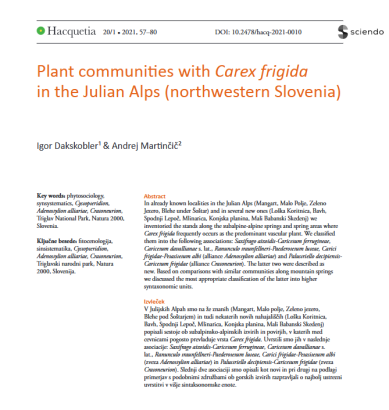
Plant communities with Carex frigida in the Julian Alps (northwestern Slovenia)
In already known localities in the Julian Alps (Mangart, Malo Polje, Zeleno Jezero, Blehe under Šoštar) and in several new ones (Loška Koritnica, Bavh, Spodnji Lepoč, Mlinarica, Konjska planina, Mali Babanski Skedenj) we inventoried the stands along the subalpine-alpine springs and spring areas where Carex frigida frequently occurs as the predominant vascular plant. We classified them into the following associations: Saxifrago aizoidis-Caricetum ferrugineae, Caricetum davallianae s. lat., Ranunculo traunfellneri-Paederotetum luteae, Carici frigidae-Petasitetum albi (alliance Adenostylion alliariae) and Palustriello decipientis- Caricetum frigidae (alliance Cratoneurion). The latter two were described as new. Based on comparisons with similar communities along mountain springs we discussed the most appropriate classification of the latter into higher syntaxonomic units.
Source
Digitalna knjižnica Slovenije, ZRC SAZU, Biološki inštitut Jovana Hadžija
Year
2021
Type
Thesis
Format
Website
Authors
Igor Dakskobler, Andrej Martinčič, Andreja Šalamon
Keywords
Phytosociology, synsystematics, Cystopteridion, Adenostylion alliariae, Cratoneurion, Triglav National Park, Natura 2000, Slovenia
Območja
Triglav National Park, Alps
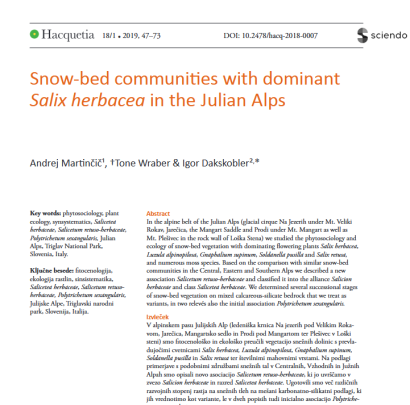
Snow-bed communities with dominant Salix herbacea in the Julian Alps
In the alpine belt of the Julian Alps (glacial cirque Na Jezerih under Mt. Veliki Rokav, Jarečica, the Mangart Saddle and Prodi under Mt. Mangart as well as Mt. Plešivec in the rock wall of Loška Stena) we studied the phytosociology and ecology of snow-bed vegetation with dominating flowering plants Salix herbacea, Luzula alpinopilosa, Gnaphalium supinum, Soldanella pusilla and Salix retusa, and numerous moss species. Based on the comparison with similar snow-bed communities in the Central, Eastern and Southern Alps we described a new association Salicetum retuso-herbaceae and classified it into the alliance Salicion herbaceae and class Salicetea herbaceae. We determined several successional stages of snow-bed vegetation on mixed calcareous-silicate bedrock that we treat as variants, in two relevés also the initial association Polytrichetum sexangularis.
Source
Digitalna knjižnica Slovenije, ZRC SAZU, Biološki inštitut Jovana Hadžija
Year
2018
Type
Thesis
Format
Website
Authors
Andrej Martinčič, Tone Wraber, Igor Dakskobler, Andreja Šalamon
Keywords
Phytosociology, plant ecology, synsystematics, Salicetea herbaceae, Salicetum retuso-herbaceae, Polytrichetum sexangularis, Julian
Alps, Triglav National Park, Slovenia, Italy
Območja
Triglav National Park, Alps
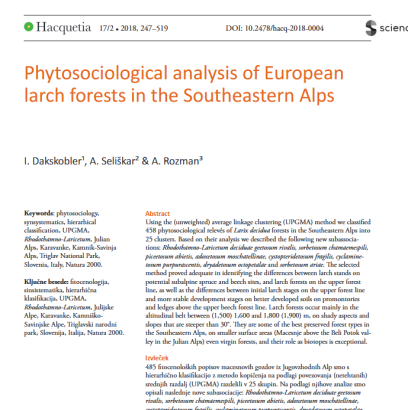
Phytosociological analysis of European larch forests in the Southeastern Alps
Using the (unweighted) average linkage clustering (UPGMA) method we classified 458 phytosociological relevés of Larix decidua forests in the Southeastern Alps into 25 clusters. Based on their analysis we described the following new subassociations: Rhodothamno-Laricetum deciduae geetosum rivalis, sorbetosum chamaemespili, piceetosum abietis, adoxetosum moschatellinae, cystopteridetosum fragilis, cyclaminetosum purpurascentis, dryadetosum octopetalae and sorbetosum ariae. The selected
method proved adequate in identifying the differences between larch stands on potential subalpine spruce and beech sites, and larch forests on the upper forest line, as well as the differences between initial larch stages on the upper forest line
and more stable development stages on better developed soils on promontories and ledges above the upper beech forest line. Larch forests occur mainly in the altitudinal belt between (1,500) 1,600 and 1,800 (1,900) m, on shady aspects and slopes that are steeper than 30°. They are some of the best preserved forest types in the Southeastern Alps, on smaller surface areas (Macesnje above the Beli Potok valley in the Julian Alps) even virgin forests, and their role as biotopes is exceptional.
Source
Digitalna knjižnica Slovenije, ZRC SAZU, Biološki inštitut Jovana Hadžija
Year
2018
Type
Thesis
Format
Website
Authors
Igor Dakskobler, Andrej Seliškar, Andrej Rozman, Andreja Šalamon
Keywords
Phytosociology, synsystematics, hierarhical classification, UPGMA, Rhodothamno-Laricetum, Julian Alps, Karavanke, Kamnik-Savinja Alps, Triglav National Park, Slovenia, Italy, Natura 2000
Območja
Triglav National Park, Alps, Slovenia
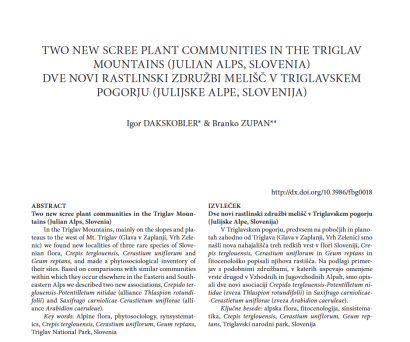
Two new scree plant communities in the Triglav Mountains (Julian Alps, Slovenia)
In the Triglav Mountains, mainly on the slopes and plateaus to the west of Mt. Triglav (Glava v Zaplanji, Vrh Zelenic) we found new localities of three rare species of Slovenian flora, Crepis terglouensis, Cerastium uniflorum and Geum reptans, and made a phytosociological inventory of their sites. Based on comparisons with similar communities within which they occur elsewhere in the Eastern and Southeastern Alps we described two new associations, Crepido terglouensis-Potentilletum nitidae (alliance Thlaspion rotundifolii) and Saxifrago carniolicae-Cerastietum uniflorae (alliance Arabidion caeruleae).
Source
Digitalna knjižnica Slovenije, Slovenska akademija znanosti in umetnosti
Year
2017
Type
Original scientific article
Format
Website
Authors
Igor Dakskobler, Branko Zupan
Keywords
Alpine flora, phytosociology, synsystematics, Crepis terglouensis, Cerastium uniflorum, Geum reptans, Triglav National Park, Slovenia
Območja
Triglav National Park, Alps
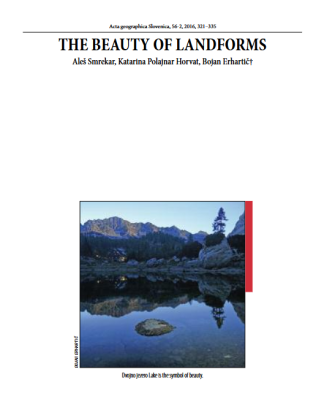
The beauty of landforms
This article determines which landforms attract people the most and whether one can speak of collective patterns in the aesthetic evaluation of a landscape. It therefore concerns enjoying the beauty offered by a more or less reshaped natural environment. This study is based on the Triglav Lakes Valley (Dolina Triglavskih jezer) in Slovenia which, due to the few man-made changes introduced there, includes hardly any anthropogenic »unnecessary noise.« The online survey included more than six hundred people and used photos of various landforms. Lakes were found to be the most attractive to the respondents, and fractured rock areas were the least attractive.
Source
Digitalna knjižnica Slovenije, Slovenska akademija znanosti in umetnosti, Založba ZRC
Year
2016
Type
Thesis
Format
Website
Authors
Aleš Smrekar, Katarina Polajnar Horvat, Bojan Erhartič, Manca Volk Bahun
Keywords
Geography, aesthetics, photography, nature, landscape online survey, Dolina Triglavskih jezer, Triglav National Park, Slovenia
Območja
Triglav National Park, Alps
Flora and vegetation in Pokljuka Gorge (Julian Alps, NW Slovenia)
The vascular flora and vegetation of Pokljuka Gorge are described. Five forest and one shrub community and 262 taxons of vascular flora were identified. Central European flora predominate, with 158 (60,3%), there are 11 (4,2%) species of Illyrian flora, 14 (5,3%) protected species and the subendemic species Saxifraga burseriana is also present. We classified the forest and shrub associations into Central European phytocenoses, although more widespread southeast European-Illyrian species are present in some.
Source
Digitalna knjižnica Slovenije, Slovenska akademija znanosti in umetnosti
Year
2015
Type
Thesis
Format
Document (PDF, DOC, ...)
Authors
Mitja Zupančič, Jože Skumavec
Keywords
Flora, vegetation, Alpine region of Slovenia, Triglav National Park, Pokljuka Gorge
Območja
Triglav National Park, Alps
Upgrading the Network of High Mountain Shelter as A Method of Restoring of Demographically Endangered Settlements in the Slovenian Alps
The paper focuses on the interdependence between the development of demographically endangered settlements and the frequency of mountain accidents in the Triglav National Park in the Slovenian Alps. Using statistical data analyses of the Mountain Rescue Association of Slovenia, field surveys and spatial information of the Surveying and Mapping Authority of the Republic of Slovenia, conclusions were reached, which redefined the existing settlement pattern of alpine shelters and mountain pastures, to encourage safe mountaineering and the development of tourism. The upgraded network of Alpine posts is designed as an upgrade of
the existing system of providing safety for the visitors to the high mountain regions of the Triglav National Park. At the same time, it offers a new format of tourist services as an opportunity to develop local economies in demographically endangered environments. The dual function (rescue services and tourism) reduces investment and maintenance costs and increases the efficiency in the exploitation of the network of paths and Alpine posts, hence it is feasible also in demographically endangered areas. It is one of the operational tools for stopping further decline in population.
Source
COBISS, De Gruyter Open, De Gruyter Poland
Year
2014
Type
Original scientific article
Format
Document (PDF, DOC, ...)
Authors
Ilka Čerpes, Nina Pandol, Alenka Fikfak
Keywords
Demographically endangered settlements, mountain accidents, Triglav National Park, hiking, tourist development, Alpine settlement, Alpine huts and shelters
Območja
Triglav National Park, Alps
Evaluation of hikers’ pro-environmental behaviour in Triglav National Park, Slovenia
The paper discusses the factors that influence hikers’ pro-environmental behaviour and explores the relationship between the level of education and their environmentally friendly behaviour at home. It also examines the importance of nature preservation characteristics in hikers’ choice of vacation destinations. The research provides valuable data for understanding hikers’ behaviour and offers suggestions for protected area managers to develop tourism offers that are more educational and environmentally friendly.
Source
ResearchGate
Year
2013
Type
Research
Format
Website
Author
Mojca Stubelj Ars
Keywords
Alps, pro-environmental behaviour, conservation, hiking, protected area management
Območja
Triglav National Park, Alps, Slovenia
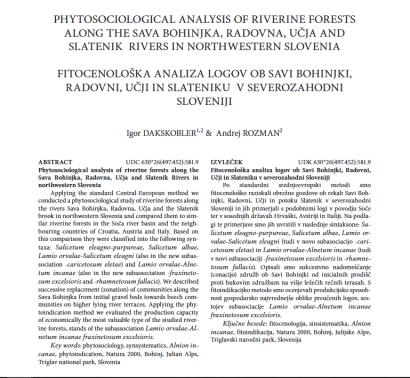
Phytosociological analysis of riverine forests along the Sava Bohinjka, Radovna, Učja and Slatenik Rivers in northwestern Slovenia
Applying the standard Central-European method we conducted a phytosociological study of riverine forests along the rivers Sava Bohinjka, Radovna, Učja and the Slatenik brook in northwestern Slovenia and compared them to similar riverine forests in the Soča river basin and the neighbouring countries of Croatia, Austria and Italy. Based on this comparison they were classified into the following syntaxa: Salicetum eleagno-purpureae, Salicetum albae,
Lamio orvalae-Salicetum eleagni (also in the new subassociation -caricetosum eletae) and Lamio orvalae-Alnetum incanae (also in the new subassociation -fraxinetosum excelsioris and -rhamnetosum fallacis). We described successive replacement (zonation) of communities along the Sava Bohinjka from initial gravel beds towards beech communities on higher lying river terraces. Applying the phytoindication method we evaluated the production capacity
of economically the most valuable type of the studied riverine forests, stands of the subassociation Lamio orvalae-Alnetum incanae fraxinetosum excelsioris.
Source
Digitalna knjižnica Slovenije, Slovenska akademija znanosti in umetnosti
Year
2013
Type
Thesis
Format
Website
Authors
Igor Dakskobler, Andrej Rozman
Keywords
Phytosociology, synsystematics, Alnion incanae, phytoindication, Natura 2000, Bohinj, Julian Alps, Triglav national park, Slovenia
Območja
Triglav National Park, Alps, Slovenia
Was this page helpful?
Thank you
Thank you.