
Digital library
Showing results 1 - 12/15
Andrej Zdravič: SECRETS OF SOČA – Time Horizon (Trailer)
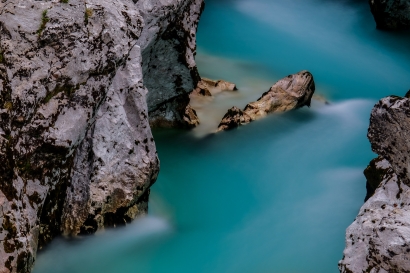
Andrej Zdravič is an award-winning filmmaker who has immersed himself in underwater filming of the Soča River, an important natural treasure of Triglav National Park. His half-hour video and sound installation Secrets of Soča is on view at the TNP Info Center Dom Trenta. The trailer you are about to watch offers only a glimpse of this unique installation.
“My first attempts at underwater filming of the Soča River in 1987 inspired me to develop a special device that allowed me to reveal visual perspectives of the Soča previously unknown to the human eye,” Andrej Zdravič wrote about the permanent video installation, originally created in 1995 and, more than three decades later, presented in a renewed form at the TNP Info Center Dom Trenta.
The filmmaker captured the Soča in a unique way throughout all seasons of the year. The video installation thus becomes “a wreath of songs of the Soča River. Each song reveals, through image and sound, one of the many states of life arising from the movement and phenomena of the river’s waters: Mysterious Source, Light Rays, Undulations, Black Water, Droplets of Snow, Summer Forest, Little Cascade, Air Manes, Secret Pulse, Trout Games, Dance of Pebbles, Chalk, Little Beach, Water Sky, Liquid Glass, Funnels, Swift Current, Spaces, Guardian of the Deep, Stormy Stream, Autumn, Leaves and Rain, Swarm of Light, The Source, Mount Triglav.”
Secrets of Soča installation unfolds before visitors to The TNP Info Center Dom Trenta across multiple television screens. Conceptually, the program is based on the Time Horizon concept, first realized by Andrej Zdravič in 1993 in the installation Water Waves for the Exploratorium, a museum of science, tehnology, and art in San Francisco.
A few words about the author: In 1999, Andrej Zdravič received the Prešeren Fund Award. Two decades later, he was honored with the Badjura Award for Lifetime Achievement. Over the course of his creative career, Andrej Zdravič has produced nearly 40 films and video installations, including the one that reveals to visitors of TNP Info Center Dom Trenta a previously unseen, hidden underwater world of the emerald river.
Source
You Tube, Triglavski narodni park
Year
2025
Type
Video clip
Format
Video
Author
Andrej Zdravič
Keywords
Triglavski narodni park, Triglav National Park, Soča, Soca River, Trenta, Slovenija, Slovenia
Območja
Triglav National Park, Alps, Slovenia
Exploring Triglav National Park: Stories of Summiting Slovenia's Iconic Peak and the Splendour of the Park
This time, Feel Slovenia the Podcast explores Triglav National Park, Slovenia's only national park. The episode celebrates the park's 100th anniversary, highlighting its significance as a protected landscape under UNESCO. The focus is on responsible and sustainable tourism, with emphasis on Mount Triglav, Slovenia's highest peak. Various guests share their experiences and insights, including climbers, comedians, authors, and tourism directors, discussing the symbolism of Triglav and the park's trails. With laughter, awe, and wisdom, the episode promotes mutual respect between tourists and locals, emphasizing the park's role in balancing nature conservation and tourism.
Source
FEEL Slovenia Podcast
Year
2024
Type
Podcast
Format
Audio
Keywords
Triglav national park, responsible and sustainable tourism, Triglav
Območja
Triglav National Park, Alps, Slovenia
Phytosociological description of the dwarf mountain pine shrub community (Amelanchiero ovalis-Pinetum mugo) in the valleys of the Slovenian Alps
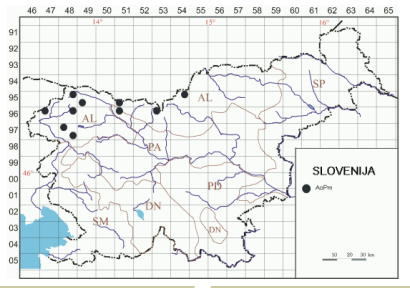
We have expanded our knowledge of the localities, sites and distribution of the Amelanchiero ovalis-Pinetum mugo association in the Slovenian Alps. Based on phytocenological analyses, the shrub association belonging to the forest vegetation type Alpine mountain pine scrub was divided into two subassociations: peucedanetosum oreoselini and hylocomiadelphetosum triquetri. We also described four variants within the latter association.
Source
University of Ljubljana, Biotehniška fakulteta
Year
2023
Type
Original scientific article
Format
Website
Authors
Igor Dakskobler, Mateja Cojzer, Andrej Rozman
Keywords
Phytosociology, synsystematics, Pinus mugo, Natura 2000, Triglav National Park, Topla Landscape Park, Slovenia
Območja
Triglav National Park, Slovenia
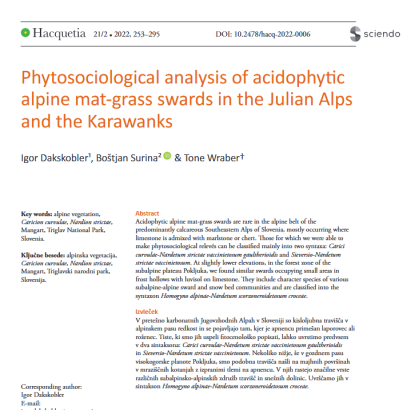
Phytosociological analysis of acidophytic alpine mat-grass swards in the Julian Alps and the Karawanks
Acidophytic alpine mat-grass swards are rare in the alpine belt of the predominantly calcareous Southeastern Alps of Slovenia, mostly occurring where limestone is admixed with marlstone or chert. Those for which we were able to make phytosociological relevés can be classified mainly into two syntaxa: Carici curvulae-Nardetum strictae vaccinietosum gaultherioidis and Sieversio-Nardetum strictae vaccinietosum. At slightly lower elevations, in the forest zone of the subalpine plateau Pokljuka, we found similar swards occupying small areas in frost hollows with luvisol on limestone. They include character species of various subalpine-alpine sward and snow bed communities and are classified into the syntaxon Homogyno alpinae-Nardetum scorzoneroidetosum croceae.
Source
Digitalna knjižnica Slovenije, ZRC SAZU, Biološki inštitut Jovana Hadžija
Year
2022
Type
Thesis
Format
Website
Authors
Igor Dakskober, Boštjan Surina, Tone Weber
Keywords
Alpine vegetation, Caricion curvulae, Nardion strictae, Mangart, Triglav National Park, Slovenia
Območja
Triglav National Park, Alps, Slovenia
Forests and climate change
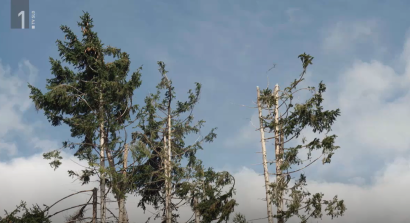
Slovenian forests are a national natural treasure that we aim to preserve for future generations. Therefore, the natural disasters that have struck Slovenia's forests over the past decade serve as a serious warning that adaptations in forest stands will be essential. Forestry experts are conducting research that is already providing initial answers to questions about how to assist forests in adapting to inevitable changes in temperature and humidity, strong winds, and extreme weather events.
The broadcast highlights the LIFEGENMON project, in which experts from the Slovenian Forestry Institute monitor the genetic diversity of fir and beech, exploring how to preserve and utilize this diversity for the benefit of the forest. In the future, beech, the queen of Slovenian forests, will increasingly replace the sensitive spruce in areas where harsher conditions due to climate change are certain to arise.
Source
RTV Slovenia (RTV365)
Year
2021
Type
Video clip
Format
Video
Keywords
forest, wood, nature conservation, climate change
Območja
Slovenia
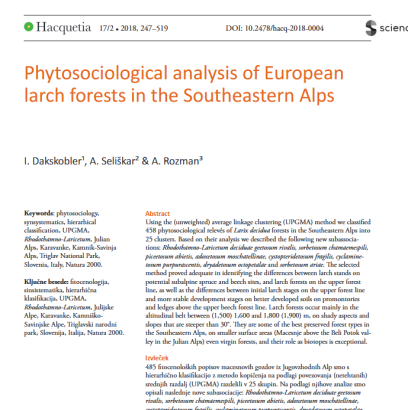
Phytosociological analysis of European larch forests in the Southeastern Alps
Using the (unweighted) average linkage clustering (UPGMA) method we classified 458 phytosociological relevés of Larix decidua forests in the Southeastern Alps into 25 clusters. Based on their analysis we described the following new subassociations: Rhodothamno-Laricetum deciduae geetosum rivalis, sorbetosum chamaemespili, piceetosum abietis, adoxetosum moschatellinae, cystopteridetosum fragilis, cyclaminetosum purpurascentis, dryadetosum octopetalae and sorbetosum ariae. The selected
method proved adequate in identifying the differences between larch stands on potential subalpine spruce and beech sites, and larch forests on the upper forest line, as well as the differences between initial larch stages on the upper forest line
and more stable development stages on better developed soils on promontories and ledges above the upper beech forest line. Larch forests occur mainly in the altitudinal belt between (1,500) 1,600 and 1,800 (1,900) m, on shady aspects and slopes that are steeper than 30°. They are some of the best preserved forest types in the Southeastern Alps, on smaller surface areas (Macesnje above the Beli Potok valley in the Julian Alps) even virgin forests, and their role as biotopes is exceptional.
Source
Digitalna knjižnica Slovenije, ZRC SAZU, Biološki inštitut Jovana Hadžija
Year
2018
Type
Thesis
Format
Website
Authors
Igor Dakskobler, Andrej Seliškar, Andrej Rozman, Andreja Šalamon
Keywords
Phytosociology, synsystematics, hierarhical classification, UPGMA, Rhodothamno-Laricetum, Julian Alps, Karavanke, Kamnik-Savinja Alps, Triglav National Park, Slovenia, Italy, Natura 2000
Območja
Triglav National Park, Alps, Slovenia
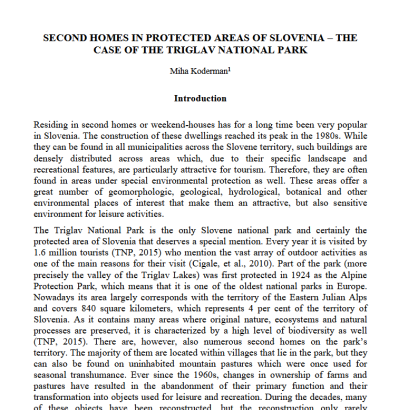
Second Homes in Protected Areas of Slovenia – The Case of the Triglav National Park
Residing in second homes or weekend-houses has for a long time been very popular in Slovenia. The construction of these dwellings reached its peak in the 1980s. While they can be found in all municipalities across the Slovene territory, such buildings are densely distributed across areas which, due to their specific landscape and recreational features, are particularly attractive for tourism. Therefore, they are often found in areas under special environmental protection as well. These areas offer a great number of geomorphologic, geological, hydrological, botanical and other
environmental places of interest that make them an attractive, but also sensitive environment for leisure activities.
Source
Univerza v Beogradu, Fakulteta za geografijo
Year
2017
Type
Research
Format
Website
Author
Miha Koderman
Keywords
Triglav national park, second homes
Območja
Triglav National Park, Slovenia
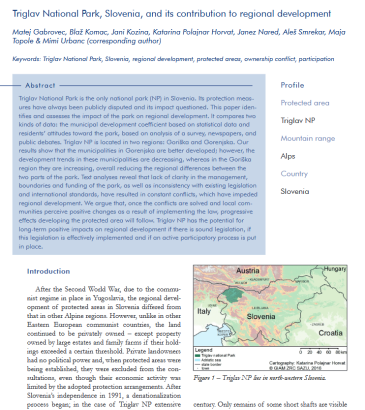
Triglav National Park, Slovenia, and its contribution to regional development
Triglav National Park is the only national park (NP) in Slovenia. Its protection measures have always been publicly disputed and its impact questioned. This paper identifies and assesses the impact of the park on regional development. It compares two kinds of data: the municipal development coefficient based on statistical data and
residents’ attitudes toward the park, based on analysis of a survey, newspapers, and public debates. Triglav NP is located in two regions: Goriška and Gorenjska. Our results show that the municipalities in Gorenjska are better developed; however, the
development trends in these municipalities are decreasing, whereas in the Goriška region they are increasing, overall reducing the regional differences between the two parts of the park. Text analyses reveal that lack of clarity in the management, boundaries and funding of the park, as well as inconsistency with existing legislation and international standards, have resulted in constant conflicts, which have impeded regional development. We argue that, once the conflicts are solved and local communities perceive positive changes as a result of implementing the law, progressive
effects developing the protected area will follow. Triglav NP has the potential for long-term positive impacts on regional development if there is sound legislation, if this legislation is effectively implemented and if an active participatory process is put in place.
Source
ResearchGate
Year
2017
Type
Research
Format
Website
Authors
Matej Gabrovec, Blaž Komac, Jani Kozina, Katarina Polajnar Horvat, Janez Nared, Aleš Smrekar, Maja Topole, Mimi Urbac
Keywords
Triglav National Park, Slovenia, regional development, protected areas, ownership conflict, participation
Območja
Triglav National Park, Slovenia
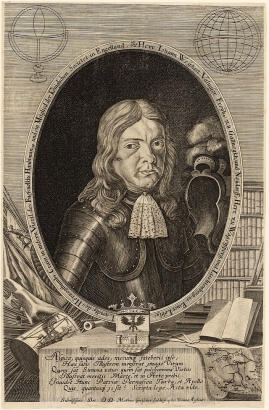
Documentary film: Valvasor's Glory
Valvasor’s The Glory of the Duchy of Carniola, first published in the distant year of 1689 and now translated into Slovenian, is an exceptional historical publication highly regarded across all fields of science, from natural sciences to humanities and social sciences. The third book of The Glory is particularly rich in illustrations and content that appeals to a broader audience, making it widely used. A copy of this work, heavily worn and damaged over the centuries, was entrusted for restoration to the Center for the Conservation and Restoration of Written and Graphic Heritage at the Archives of the Republic of Slovenia.
The broadcast, authored by Jadran Sterle and Tugo Štiglic in collaboration with Prof. Dr. Jedert Vodopivec Tomažič from the Archives of the Republic of Slovenia, delves into the fascinating discoveries of the material aspects of The Glory of the Duchy of Carniola, explores the technical background of its creation, and demonstrates how such a priceless book can be restored.
Source
RTV Slovenia (RTV365)
Year
2016
Type
Video clip
Format
Video
Keywords
Janez Vajkard Valvasor, history, The Glory of the Duchy of Carniola
Območja
Slovenia, World
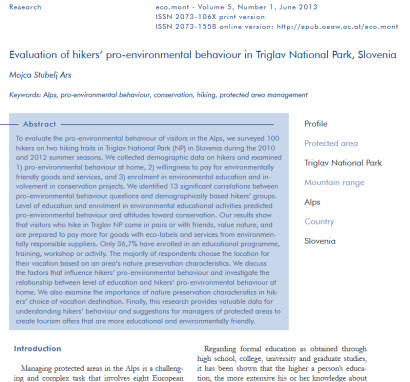
Evaluation of hikers’ pro-environmental behaviour in Triglav National Park, Slovenia
The paper discusses the factors that influence hikers’ pro-environmental behaviour and explores the relationship between the level of education and their environmentally friendly behaviour at home. It also examines the importance of nature preservation characteristics in hikers’ choice of vacation destinations. The research provides valuable data for understanding hikers’ behaviour and offers suggestions for protected area managers to develop tourism offers that are more educational and environmentally friendly.
Source
ResearchGate
Year
2013
Type
Research
Format
Website
Author
Mojca Stubelj Ars
Keywords
Alps, pro-environmental behaviour, conservation, hiking, protected area management
Območja
Triglav National Park, Alps, Slovenia
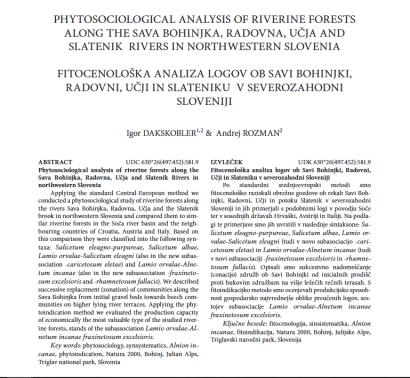
Phytosociological analysis of riverine forests along the Sava Bohinjka, Radovna, Učja and Slatenik Rivers in northwestern Slovenia
Applying the standard Central-European method we conducted a phytosociological study of riverine forests along the rivers Sava Bohinjka, Radovna, Učja and the Slatenik brook in northwestern Slovenia and compared them to similar riverine forests in the Soča river basin and the neighbouring countries of Croatia, Austria and Italy. Based on this comparison they were classified into the following syntaxa: Salicetum eleagno-purpureae, Salicetum albae,
Lamio orvalae-Salicetum eleagni (also in the new subassociation -caricetosum eletae) and Lamio orvalae-Alnetum incanae (also in the new subassociation -fraxinetosum excelsioris and -rhamnetosum fallacis). We described successive replacement (zonation) of communities along the Sava Bohinjka from initial gravel beds towards beech communities on higher lying river terraces. Applying the phytoindication method we evaluated the production capacity
of economically the most valuable type of the studied riverine forests, stands of the subassociation Lamio orvalae-Alnetum incanae fraxinetosum excelsioris.
Source
Digitalna knjižnica Slovenije, Slovenska akademija znanosti in umetnosti
Year
2013
Type
Thesis
Format
Website
Authors
Igor Dakskobler, Andrej Rozman
Keywords
Phytosociology, synsystematics, Alnion incanae, phytoindication, Natura 2000, Bohinj, Julian Alps, Triglav national park, Slovenia
Območja
Triglav National Park, Alps, Slovenia
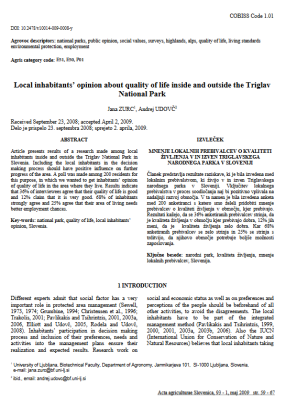
Local inhabitants' opinion about quality of life inside and outside the Triglav National Park
Article presents results of a research made among local inhabitants inside and outside the Triglav National Park in Slovenia. Including the local inhabitants in the decision making process should have positive influence on further progress of the area. A poll was made among 200 residents for this purpose, in which we wanted to get inhabitants’ opinion of quality of life in the area where they live. Results indicate that 36% of interviewees agree that their quality of life is good and 12% claim that it is very good. 68% of inhabitants
strongly agree and 25% agree that their area of living needs better employment chances.
Source
University of Ljubljana, Biotehniška fakulteta
Year
2009
Type
Original scientific article
Format
Website
Authors
Jana Zurc, Andrej Udovč
Keywords
National park, quality of life, local inhabitants’ opinion, Slovenia
Območja
Triglav National Park, Slovenia
Was this page helpful?
Thank you
Thank you.