
Digital library
Showing results 48 - 60/158
New localities of Adiantum capillus-veneris and Moehringia villosa in the southern Julian Alps
The article describes new localities of two rare species
of conservation importance of Slovenian flora in the southern julian alps (the tolmin-bohinj and Krn Mts.). The stands of the Mediterranean species Adiantum capillus-veneris in Kneška grapa gorge under Mt. Masovnik (Kneške Ravne) at elevations 570–600 m are assigned to the new variant Eucladio-Adiantetum hymenostylietosum recurvirostri var. Astrantia carniolica. Moehringia villosa, an endemic species of european conservation importance, has its north- westernmost locality in its entire distribution range at curk waterfall in the spring area of the Kozjak under Mt. Krnčica,
where it occurs in the stands of the variant Campanulo carnicae-Moehringietum villosae var. Paederota lutea.
Source
Digitalna knjižnica Slovenije, Slovenska akademija znanosti in umetnosti
Year
2021
Type
Original scientific article
Format
Website
Authors
Igor Dakskobler, Andrej Martinčič, Andreja Šalamon
Keywords
Flora, vegetation, Adiantum capillus-veneris, Moehringia villosa, natura 2000, triglav national park, Slovenia
Območja
Triglav National Park, Alps
Recreation effects on wildlife: a review of potential quantitative thresholds
Outdoor recreation is increasingly recognised for its deleterious effects on wildlife individuals and populations. However, planners and natural resource managers lack robust scientific recommendations for the design of recreation infrastructure and management of recreation activities. We reviewed 38 years of
research on the effect of non-consumptive recreation on wildlife to attempt to identify effect thresholds or the point at which recreation begins to exhibit behavioural or physiological change to wildlife. We
found that 53 of 330 articles identified a quantitative threshold. The majority of threshold articles focused on bird or mammal species and measured the distance to people or to a trail. Threshold distances varied substantially within and amongst taxonomic groups. Threshold distances for wading and passerine birds
were generally less than 100 m, whereas they were greater than 400 m for hawks and eagles. Mammal threshold distances varied widely from 50 m for small rodents to 1,000 m for large ungulates. We did not find a significant difference between threshold distances of different recreation activity groups, likely based in part on low sample size. There were large gaps in scientific literature regarding several recreation variables and taxonomic groups including amphibians, invertebrates and reptiles. Our findings exhibit the
need for studies to measure continuous variables of recreation extent and magnitude, not only to detect effects of recreation on wildlife, but also to identify effect thresholds when and where recreation begins or ceases to affect wildlife. Such considerations in studies of recreation ecology could provide robust scientific
recommendations for planners and natural resource managers for the design of recreation infrastructure and management of recreation activities.
Source
ResearchGate, Ostalo
Year
2021
Type
Original scientific article
Format
Website
Authors
Jeremy S. Dertien, Courtney L. Larson, Sarah E. Reed
Keywords
Distance to people, human disturbance, park management, protected areas, recreation impacts, wildlife conservation
Območja
World
Framework for Sustainable Recovery of Tourism in Protected Areas
Tourism in protected areas was a fast-growing segment within the global travel and tourism industry prior to the economic fallout from the COVID-19 pandemic. As a development pathway, tourism generated foreign exchange for countries endowed with natural assets (protected areas, pristine landscapes, forests, oceans, wildlife), contributed to conservation revenues, and provided
local development benefits for communities. However, the spread of COVID-19 and its associated travel restrictions severely impacted this sector. In this review, we describe the main challenges preventing the sector from achieving its development potential. We propose a framework to steer tourism in protected areas as a green recovery initiative, so that it may rebound sustainably and continue to support biodiversity conservation and socio-economic development.
Source
ResearchGate
Year
2021
Type
Research
Format
Website
Authors
Hasita Bhammar, Wendy Li, Christel Maria Moller Molina, Valerie Hickey, Jo Pendry, Urvashi Narian
Keywords
Tourism, sustainability, protected area, biodiversity, COVID-19, recovery
Območja
World
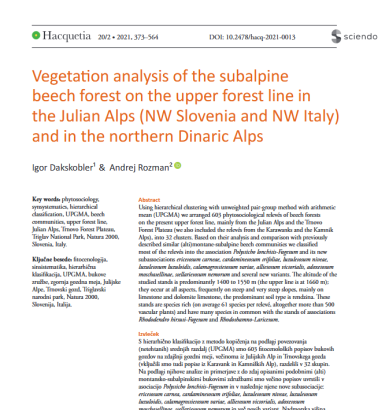
Vegetation analysis of the subalpine beech forest on the upper forest line in the Julian Alps (NW Slovenia and NW Italy) and in the northern Dinaric Alps
Using hierarchical clustering with unweighted pair-group method with arithmetic mean (UPGMA) we arranged 603 phytosociological relevés of beech forests on the present upper forest line, mainly from the Julian Alps and the Trnovo Forest Plateau (we also included the relevés from the Karawanks and the Kamnik Alps), into 32 clusters. Based on their analysis and comparison with previously described similar (alti)montane-subalpine beech communities we classified most of the relevés into the association Polysticho lonchitis-Fagetum and its new subassociations ericetosum carneae, cardaminetosum trifoliae, luzuletosum niveae, luzuletosum luzuloidis, calamagrostietosum variae, allietosum victorialis, adoxetosum moschatellinae, stellarietosum nemorum and several new variants. The altitude of the studied stands is predominantly 1400 to 1550 m (the upper line is at 1660 m); they occur at all aspects, frequently on steep and very steep slopes, mainly on limestone and dolomite limestone, the predominant soil type is rendzina. These stands are species rich (on average 61 species per relevé, altogether more than 500 vascular plants) and have many species in common with the stands of associations Rhododendro hirsuti-Fagetum and Rhodothamno-Laricetum.
Source
Digitalna knjižnica Slovenije, ZRC SAZU, Biološki inštitut Jovana Hadžija
Year
2021
Type
Thesis
Format
Website
Authors
Igor Dakskobler, Andrej Rozman, Andreja Šalamon
Keywords
Phytosociology, synsystematics, hierarchical classification, UPGMA, beech communities, upper forest line, Julian Alps, Trnovo Forest Plateau, Triglav National Park, Natura 2000, Slovenia, Italy
Območja
Triglav National Park, Alps
Forests and climate change
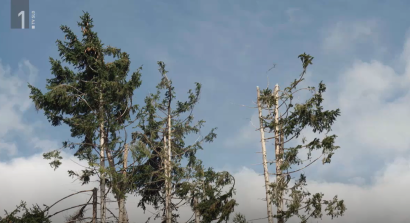
Slovenian forests are a national natural treasure that we aim to preserve for future generations. Therefore, the natural disasters that have struck Slovenia's forests over the past decade serve as a serious warning that adaptations in forest stands will be essential. Forestry experts are conducting research that is already providing initial answers to questions about how to assist forests in adapting to inevitable changes in temperature and humidity, strong winds, and extreme weather events.
The broadcast highlights the LIFEGENMON project, in which experts from the Slovenian Forestry Institute monitor the genetic diversity of fir and beech, exploring how to preserve and utilize this diversity for the benefit of the forest. In the future, beech, the queen of Slovenian forests, will increasingly replace the sensitive spruce in areas where harsher conditions due to climate change are certain to arise.
Source
RTV Slovenia (RTV365)
Year
2021
Type
Video clip
Format
Video
Keywords
forest, wood, nature conservation, climate change
Območja
Slovenia
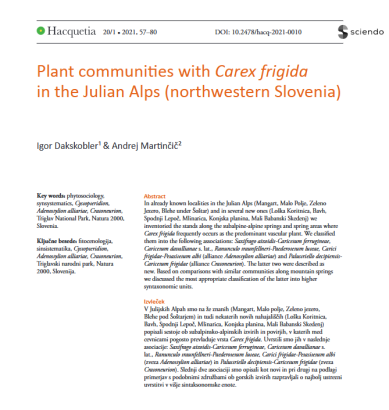
Plant communities with Carex frigida in the Julian Alps (northwestern Slovenia)
In already known localities in the Julian Alps (Mangart, Malo Polje, Zeleno Jezero, Blehe under Šoštar) and in several new ones (Loška Koritnica, Bavh, Spodnji Lepoč, Mlinarica, Konjska planina, Mali Babanski Skedenj) we inventoried the stands along the subalpine-alpine springs and spring areas where Carex frigida frequently occurs as the predominant vascular plant. We classified them into the following associations: Saxifrago aizoidis-Caricetum ferrugineae, Caricetum davallianae s. lat., Ranunculo traunfellneri-Paederotetum luteae, Carici frigidae-Petasitetum albi (alliance Adenostylion alliariae) and Palustriello decipientis- Caricetum frigidae (alliance Cratoneurion). The latter two were described as new. Based on comparisons with similar communities along mountain springs we discussed the most appropriate classification of the latter into higher syntaxonomic units.
Source
Digitalna knjižnica Slovenije, ZRC SAZU, Biološki inštitut Jovana Hadžija
Year
2021
Type
Thesis
Format
Website
Authors
Igor Dakskobler, Andrej Martinčič, Andreja Šalamon
Keywords
Phytosociology, synsystematics, Cystopteridion, Adenostylion alliariae, Cratoneurion, Triglav National Park, Natura 2000, Slovenia
Območja
Triglav National Park, Alps
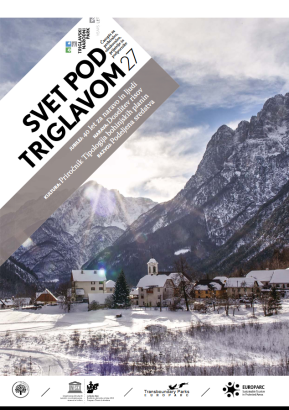
The world under Triglav (Svet pod Triglavom) (Svet pod Triglavom 27)
The newspaper is aimed at residents, visitors, fans and supporters. It is free for park residents and available at Triglav National Park information centres.
Up to two issues a year are published.
Source
TNP Publications, Triglavski narodni park
Year
2020
Type
Magazine
Format
Document (PDF, DOC, ...)
Keywords
Newspapers
Območja
Triglav National Park
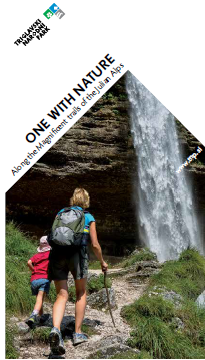
Triglav National Park leaflets (On the beautiful trails of the Julian Alps)
The leaflets provide information on various topics related to the Triglav National Park.
Source
TNP Publications, Triglavski narodni park
Year
2020
Type
Magazine
Format
Document (PDF, DOC, ...)
Keywords
Leaflets
Links
Območja
Triglav National Park
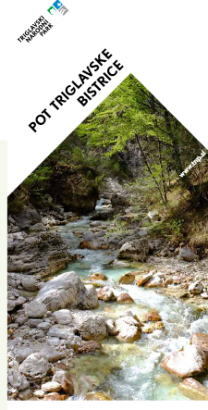
Triglav National Park leaflets (The Triglav Bistrica Trail in the Vrata Valley)
The leaflets provide information on various topics related to the Triglav National Park.
Source
TNP Publications, Triglavski narodni park
Year
2020
Type
Magazine
Format
Document (PDF, DOC, ...)
Keywords
Leaflets
Links
Območja
Triglav National Park
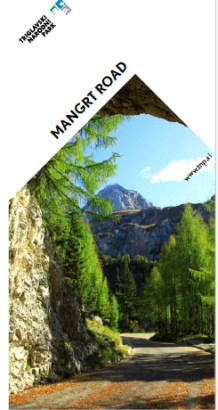
Triglav National Park leaflets (Mangrt Road)
The leaflets provide information on various topics related to the Triglav National Park.
Source
TNP Publications, Triglavski narodni park
Year
2020
Type
Magazine
Format
Document (PDF, DOC, ...)
Keywords
Leaflets
Links
Območja
Triglav National Park
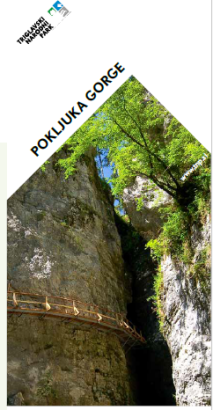
Triglav National Park leaflets ( Pokljuka Gorge)
The leaflets provide information on various topics related to the Triglav National Park.
Source
TNP Publications, Triglavski narodni park
Year
2020
Type
Magazine
Format
Document (PDF, DOC, ...)
Keywords
Leaflets
Links
Območja
Triglav National Park
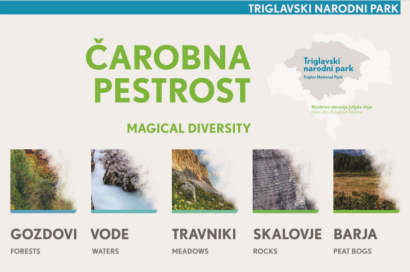
Occasional publications (Exhibition Magical Diversity)
The Triglav National Park also publishes occasional publications. They cover various topics in the fields of nature conservation, cultural heritage, research, education, etc.
Source
TNP Publications, Triglavski narodni park
Year
2020
Type
Magazine
Format
Document (PDF, DOC, ...)
Keywords
Others
Območja
Triglav National Park
Was this page helpful?
Thank you
Thank you.