
Digital library
Showing results 36 - 48/158
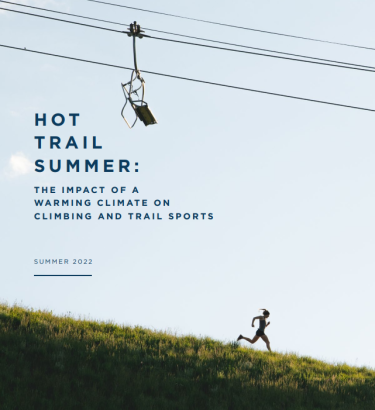
Hot trail summer: The impact of a warming climate on climbing and trail sports
This report, created in collaboration with master’s students at UC Santa Barbara’s Bren School of Environmental Science
& Management, examines how climate change impacts the rock climbing, trail running, hiking and mountain biking communities and outlines what many of us already know: that no matter the
season, a warming world has profound implications for outdoor recreation.
Source
Other
Year
2022
Type
Publication
Format
Document (PDF, DOC, ...)
Authors
Matt Koller, Karla Garibay Garcia, Sage Kime, Will Geiken, Sam Fearer
Keywords
Climate change, outdoor recreation, rock climbing, trail running, hiking, mountain biking
Območja
World
Occasional publications (Catalogue of the photo exhibition "Eternal change captured in a photographic lens" on the occasion of the 40th anniversary of the Triglav National Park)
The Triglav National Park also publishes occasional publications. They cover various topics in the fields of nature conservation, cultural heritage, research, education, etc.
Source
TNP Publications, Triglavski narodni park
Year
2022
Type
Magazine
Format
Document (PDF, DOC, ...)
Keywords
Others
Območja
Triglav National Park
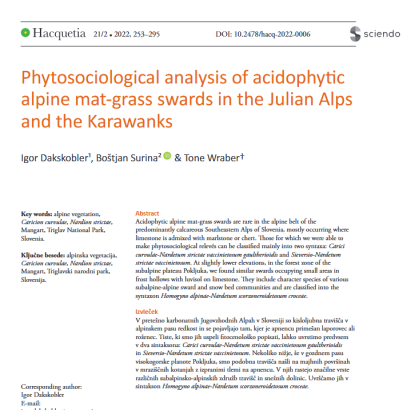
Phytosociological analysis of acidophytic alpine mat-grass swards in the Julian Alps and the Karawanks
Acidophytic alpine mat-grass swards are rare in the alpine belt of the predominantly calcareous Southeastern Alps of Slovenia, mostly occurring where limestone is admixed with marlstone or chert. Those for which we were able to make phytosociological relevés can be classified mainly into two syntaxa: Carici curvulae-Nardetum strictae vaccinietosum gaultherioidis and Sieversio-Nardetum strictae vaccinietosum. At slightly lower elevations, in the forest zone of the subalpine plateau Pokljuka, we found similar swards occupying small areas in frost hollows with luvisol on limestone. They include character species of various subalpine-alpine sward and snow bed communities and are classified into the syntaxon Homogyno alpinae-Nardetum scorzoneroidetosum croceae.
Source
Digitalna knjižnica Slovenije, ZRC SAZU, Biološki inštitut Jovana Hadžija
Year
2022
Type
Thesis
Format
Website
Authors
Igor Dakskober, Boštjan Surina, Tone Weber
Keywords
Alpine vegetation, Caricion curvulae, Nardion strictae, Mangart, Triglav National Park, Slovenia
Območja
Triglav National Park, Alps, Slovenia
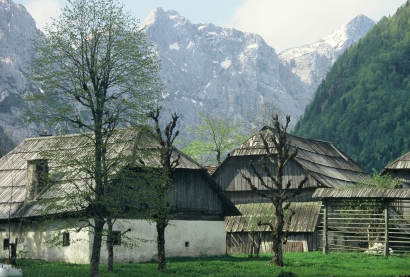
Occasional publications (Hiše naših dedov)
The Triglav National Park also publishes occasional publications. They cover various topics in the fields of nature conservation, cultural heritage, research, education, etc.
Source
TNP Publications, Triglavski narodni park
Year
2022
Type
Magazine
Format
Document (PDF, DOC, ...)
Keywords
Others
Območja
Triglav National Park
Phytosociological description of spring vegetation in the subalpine and alpine belt of the Julian Alps
Plant communities of several moss-rich calcareous water springs in the subalpine and alpine belt of the Julian Alps were phytosociologicaly investigated. Based on the comparison with similar communities in other parts of the Alps we classify them into the new association Saxifrago robustae-Palustrielletum commutati and in to two subassociations: -violetosum biflorae (mostly in the subalpine belt) and -saxifragetosum sedoidis (mostly in the alpine belt). Stands of described community belong to Natura 2000 habitat type Petrifying springs with tufa formation (Cratoneurion). For
now they are mostly not directly threatened by man.
Source
Digitalna knjižnica Slovenije, Slovenska akademija znanosti in umetnosti
Year
2022
Type
Thesis
Format
Website
Authors
Igor Dakskobler, Andrej Martinčič, Andreja Šalamon
Keywords
Vegetation, Cratoneurion, Julian Alps, Triglav National Park, Slovenia, Italy
Območja
Triglav National Park, Alps
Phytosociological analysis of Carex bicolor All. sites in the Julian Alps
We conducted a phytosociological investigation of the sites of Carex bicolor on the only known localities of this species in the Julian Alps, in the upper part of the Triglav Lakes Valley. Carex bicolor was recorded in different alpine communities, most of which belong to the class Scheuchzerio-Caricetea fuscae and order Caricetalia davallianae. We described a new association Caricetum bicolori-frigidae, which is classified into the alliance Caricion atrofusco-saxatilis and is for now the only community of this alliance in Slovenia.
Source
Digitalna knjižnica Slovenije, Slovenska akademija znanosti in umetnosti
Year
2022
Type
Thesis
Format
Website
Authors
Igor Dakskobler, Andrej Martinčič, Andreja Šalamon
Keywords
Vegetation, alpine lake, snow beds, Triglav National Park, Slovenia
Območja
Triglav National Park, Alps
The world under Triglav (Svet pod Triglavom) (Svet pod Triglavom 29)
The newspaper is aimed at residents, visitors, fans and supporters. It is free for park residents and available at Triglav National Park information centres.
Up to two issues a year are published.
Source
TNP Publications, Triglavski narodni park
Year
2021
Type
Magazine
Format
Document (PDF, DOC, ...)
Keywords
Newspapers
Območja
Triglav National Park
Covid-19 and outdoor recreation – Lessons learned? Introduction to the special issue on “Outdoor recreation and Covid-19: Its effects on people, parks and landscapes” November 2022Journal of Outdoor Recreation and Tourism 41(11):100583 DOI:10.1016/j.jort.
The special issue presents international experiences with COVID-19 in the years 2020 and 2021 on outdoor recreation and nature-based tourism. To set the scene, a bibliometric and qualitative analysis illustrates and clusters recent publications on COVID-19. Against this background contributions from Japan, China, Brazil, Indonesia, Austria, Croatia, the United States, New Zealand, Taiwan, Australia, Sweden, Poland and Ireland draw
a truly international picture of the pandemic crisis, the effects, coping behavior and related strategies. The papers contribute to the COVID-19 related research by documenting the shock in the field of outdoor recreation and tourism, by understanding the immediate consequences on behavior and the required managerial consequences and finally, by analyzing the possible follow up effects including long term effects, discussing resilient solutions
and proposing new strategies. In the discussion section we try to answer the questions whether the high visitation rate in recreation facilities, forests, parks and protected areas will remain, and whether adapted visitor management concepts will be required. In addition, we discuss possible implications for urban planning and management. Finally, based on a changing connectedness to nature also possible positive effects by the pandemic are
discussed which may lead to a new target group in outdoor recreation and nature-based tourism.

Source
ResearchGate
Year
2021
Type
Research
Format
Website
Authors
Ulrike Pröbstl-Haider , Katharina Gugerell, Sreetheran Maruthaveeran
Keywords
Covid-19 pandemic, bibliometric, visitor management, behavioural change, green infrastructure, environmental justice, new normal
Območja
World
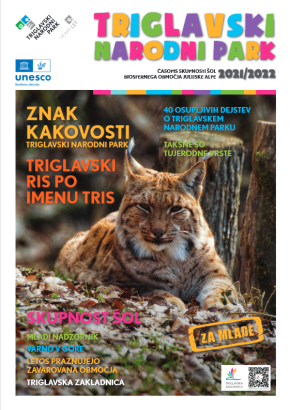
Children's newspaper (Časopis Skupnosti šol Biosfernega območja Julijske Alpe 2021 / 2022 - Jesen)
Source
TNP Publications, Triglavski narodni park
Year
2021
Type
Magazine
Format
Document (PDF, DOC, ...)
Keywords
Children's material
Območja
Triglav National Park
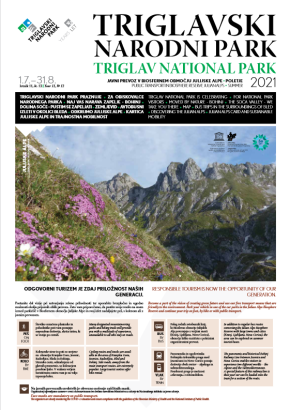
Visitor's Guide to the Julian Alps Biosphere Area - summer (Summer 2021 - public transport)
Information on organised public transport in the Triglav National Park and the Julian Alps Biosphere Area, guided tours, hints for excursions and tips for visiting.
Source
TNP Publications, Triglavski narodni park
Year
2021
Type
Magazine
Format
Document (PDF, DOC, ...)
Keywords
Guidebooks
Območja
Triglav National Park
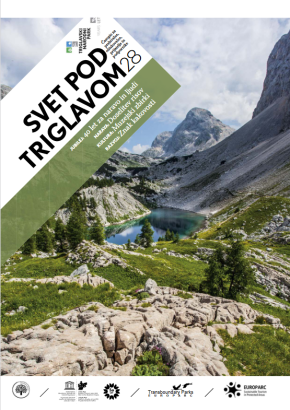
The world under Triglav (Svet pod Triglavom) (Svet pod Triglavom 28)
The newspaper is aimed at residents, visitors, fans and supporters. It is free for park residents and available at Triglav National Park information centres.
Up to two issues a year are published.
Source
TNP Publications, Triglavski narodni park
Year
2021
Type
Magazine
Format
Document (PDF, DOC, ...)
Keywords
Newspapers
Območja
Triglav National Park
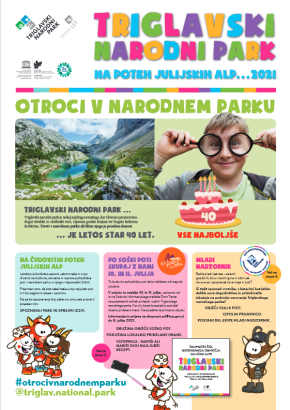
Children's newspaper (Po poteh Julijskih Alp 2021 )
Source
TNP Publications, Triglavski narodni park
Year
2021
Type
Magazine
Format
Document (PDF, DOC, ...)
Keywords
Children's material
Območja
Triglav National Park
Was this page helpful?
Thank you
Thank you.