
Digital library

Showing results 24 - 25/25
Georeferencing and quality assessment of Josephine survey maps for the mountainous region in the Triglav National Park
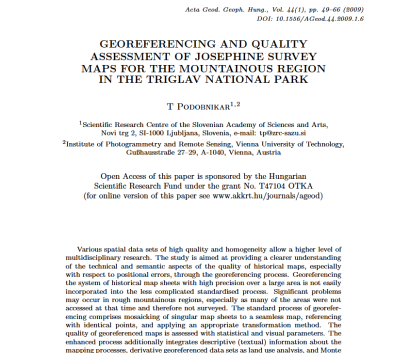
Various spatial data sets of high quality and homogeneity allow a higher level of multidisciplinary research. The study is aimed at providing a clearer understanding of the technical and semantic aspects of the quality of historical maps, especially with respect to positional errors, through the georeferencing process. Georeferencing the system of historical map sheets with high precision over a large area is not easily incorporated into the less complicated standardised process. Significant problems may occur in rough mountainous regions, especially as many of the areas were not accessed at that time and therefore not surveyed. The standard process of georefer- encing comprises mosaicking of singular map sheets to a seamless map, referencing with identical points, and applying an appropriate transformation method. The
quality of georeferenced maps is assessed with statistical and visual parameters. The enhanced process additionally integrates descriptive (textual) information about the mapping processes, derivative georeferenced data sets as land use analysis, and Monte
Carlo simulations. This approach allows a more detailed understanding of the quality and consequently improves a georeferencing process for any historical data sets. The First Military Survey maps of the Habsburg Monarchy (Josephine survey), produced between 1763 and 1787, were used as study data and the rugged Julian Alps of the Triglav National Park in Slovenia were employed as the study area.
Source
ResearchGate, Akadémiai Kiadó, Budapest
Year
2009
Type
Research
Format
Website
Author
Tomaž Podobnikar
Keywords
Error simulation, georeferencing, historical map, land use, quality
control
Območja
Triglav National Park, Alps, Slovenia
Was this page helpful?
Thank you
Thank you.