
Digital library
Showing results 72 - 84/158
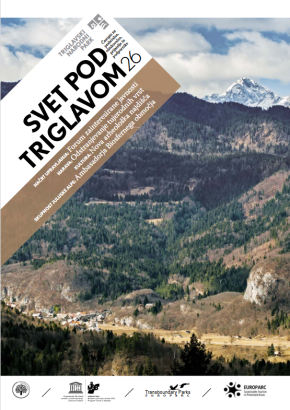
The world under Triglav (Svet pod Triglavom) (Svet pod Triglavom 26)
The newspaper is aimed at residents, visitors, fans and supporters. It is free for park residents and available at Triglav National Park information centres.
Up to two issues a year are published.
Source
TNP Publications, Triglavski narodni park
Year
2019
Type
Magazine
Format
Document (PDF, DOC, ...)
Keywords
Newspapers
Območja
Triglav National Park
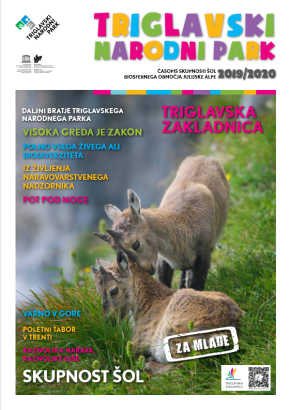
Children's newspaper (Časopis Skupnosti šol Biosfernega območja Julijske Alpe 2019 / 2020)
Source
TNP Publications, Triglavski narodni park
Year
2019
Type
Magazine
Format
Document (PDF, DOC, ...)
Keywords
Children's material
Območja
Triglav National Park
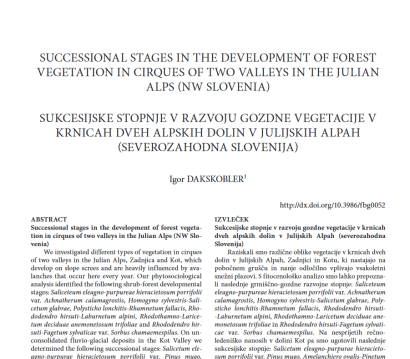
Successional stages in the development of forest vegetation in cirques of two valleys in the Julian Alps (NW Slovenia)
We investigated different types of vegetation in cirques of two valleys in the Julian Alps, Zadnjica and Kot, which develop on slope screes and are heavily influenced by avalanches that occur here every year. Our phytosociological analysis identified the following shrub-forest developmental stages: Saliceteum eleagno-purpureae hieracietosum porrifolii var. Achnatherum calamagrostis, Homogyno sylvestris-Salicetum glabrae, Polysticho lonchitis-Rhamnetum fallacis, Rhododendro hirsuti-Laburnetum alpini, Rhodothamno-Laricetum deciduae anemonetosum trifoliae and Rhododendro hirsuti-Fagetum sylvaticae var. Sorbus chamaemespilus. On unconsolidated fluvio-glacial deposits in the Kot Valley we determined the following successional stages: Salicetum eleagno-purpurae hieracietosum porrifolii var. Pinus mugo, Amelanchiero ovalis-Pinetum mugo laricetosum and Rhododendro hirsuti-Fagetum sylvaticae petasitetosum paradoxi.
Source
Digitalna knjižnica Slovenije, Slovenska akademija znanosti in umetnosti
Year
2019
Type
Original scientific article
Format
Website
Author
Igor Dakskobler
Keywords
Phytosociology, succession, glacial valley, Julian Alps, Natura 2000, Triglav National Park, Slovenia
Območja
Triglav National Park
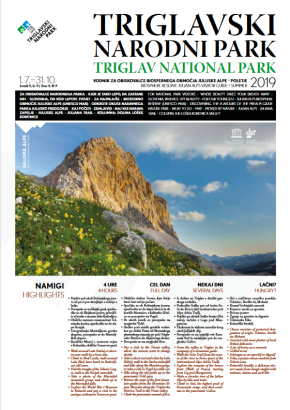
Visitor's Guide to the Julian Alps Biosphere Area - summer (Summer 2019)
Information on organised public transport in the Triglav National Park and the Julian Alps Biosphere Area, guided tours, hints for excursions and tips for visiting.
Source
TNP Publications, Triglavski narodni park
Year
2019
Type
Magazine
Format
Document (PDF, DOC, ...)
Keywords
Guidebooks
Območja
Triglav National Park
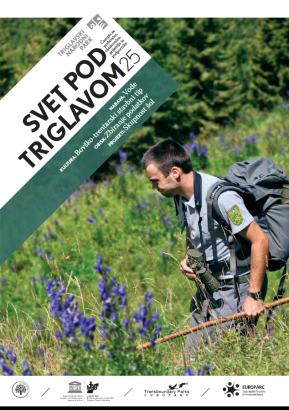
The world under Triglav (Svet pod Triglavom) (Svet pod Triglavom 25)
The newspaper is aimed at residents, visitors, fans and supporters. It is free for park residents and available at Triglav National Park information centres.
Up to two issues a year are published.
Source
TNP Publications, Triglavski narodni park
Year
2018
Type
Magazine
Format
Document (PDF, DOC, ...)
Keywords
Newspapers
Območja
Triglav National Park
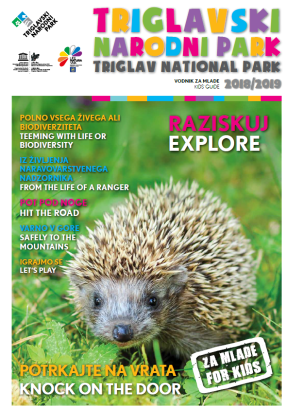
Children's newspaper (2019/202)
Source
TNP Publications, Triglavski narodni park
Year
2018
Type
Magazine
Format
Document (PDF, DOC, ...)
Keywords
Children's material
Območja
Triglav National Park
Snow-bed communities with dominant Salix herbacea in the Julian Alps
In the alpine belt of the Julian Alps (glacial cirque Na Jezerih under Mt. Veliki Rokav, Jarečica, the Mangart Saddle and Prodi under Mt. Mangart as well as Mt. Plešivec in the rock wall of Loška Stena) we studied the phytosociology and ecology of snow-bed vegetation with dominating flowering plants Salix herbacea, Luzula alpinopilosa, Gnaphalium supinum, Soldanella pusilla and Salix retusa, and numerous moss species. Based on the comparison with similar snow-bed communities in the Central, Eastern and Southern Alps we described a new association Salicetum retuso-herbaceae and classified it into the alliance Salicion herbaceae and class Salicetea herbaceae. We determined several successional stages of snow-bed vegetation on mixed calcareous-silicate bedrock that we treat as variants, in two relevés also the initial association Polytrichetum sexangularis.
Source
Digitalna knjižnica Slovenije, ZRC SAZU, Biološki inštitut Jovana Hadžija
Year
2018
Type
Thesis
Format
Website
Authors
Andrej Martinčič, Tone Wraber, Igor Dakskobler, Andreja Šalamon
Keywords
Phytosociology, plant ecology, synsystematics, Salicetea herbaceae, Salicetum retuso-herbaceae, Polytrichetum sexangularis, Julian
Alps, Triglav National Park, Slovenia, Italy
Območja
Triglav National Park, Alps
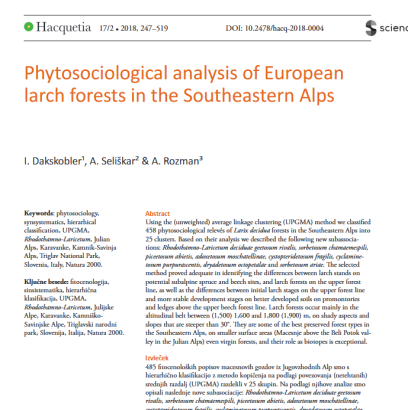
Phytosociological analysis of European larch forests in the Southeastern Alps
Using the (unweighted) average linkage clustering (UPGMA) method we classified 458 phytosociological relevés of Larix decidua forests in the Southeastern Alps into 25 clusters. Based on their analysis we described the following new subassociations: Rhodothamno-Laricetum deciduae geetosum rivalis, sorbetosum chamaemespili, piceetosum abietis, adoxetosum moschatellinae, cystopteridetosum fragilis, cyclaminetosum purpurascentis, dryadetosum octopetalae and sorbetosum ariae. The selected
method proved adequate in identifying the differences between larch stands on potential subalpine spruce and beech sites, and larch forests on the upper forest line, as well as the differences between initial larch stages on the upper forest line
and more stable development stages on better developed soils on promontories and ledges above the upper beech forest line. Larch forests occur mainly in the altitudinal belt between (1,500) 1,600 and 1,800 (1,900) m, on shady aspects and slopes that are steeper than 30°. They are some of the best preserved forest types in the Southeastern Alps, on smaller surface areas (Macesnje above the Beli Potok valley in the Julian Alps) even virgin forests, and their role as biotopes is exceptional.
Source
Digitalna knjižnica Slovenije, ZRC SAZU, Biološki inštitut Jovana Hadžija
Year
2018
Type
Thesis
Format
Website
Authors
Igor Dakskobler, Andrej Seliškar, Andrej Rozman, Andreja Šalamon
Keywords
Phytosociology, synsystematics, hierarhical classification, UPGMA, Rhodothamno-Laricetum, Julian Alps, Karavanke, Kamnik-Savinja Alps, Triglav National Park, Slovenia, Italy, Natura 2000
Območja
Triglav National Park, Alps, Slovenia
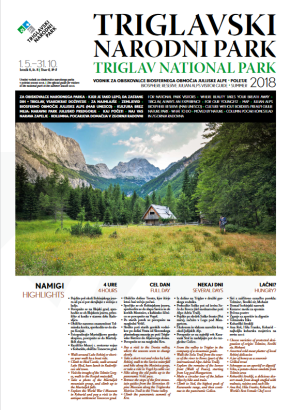
Visitor's Guide to the Julian Alps Biosphere Area - summer (Summer 2018)
Information on organised public transport in the Triglav National Park and the Julian Alps Biosphere Area, guided tours, hints for excursions and tips for visiting.
Source
TNP Publications, Triglavski narodni park
Year
2018
Type
Magazine
Format
Document (PDF, DOC, ...)
Keywords
Guidebooks
Območja
Triglav National Park
Sport and Biodiversity
Sport can have significant negative impacts on biodiversity, through the construction and use of sports venues and the staging of sporting events. Understanding and managing the potential negative impacts and opportunities for conservation is vital for ensuring that sports venues and sporting events deliver successfully both from the financial and operational standpoint. This guide is designed to help decision makers understand these potential impacts, and to present options for mitigating them, as well as for maximising opportunities to use sport as a way to promote and enhance biodiversity conservation.

Source
International Union for Conservation of Nature
Year
2018
Type
Publication
Format
Document (PDF, DOC, ...)
Keywords
Sport, negative impacts, biodiversity conservation, biodiversity
Območja
World
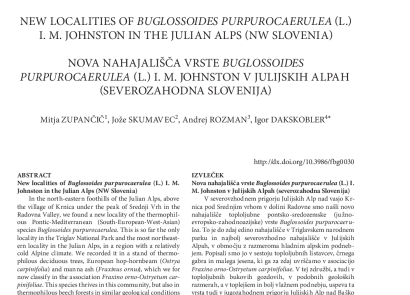
New localities of Buglossoides purpurocaerulea (L.) I. M. Johnston in the Julian Alps (NW Slovenia)
In the north-eastern foothills of the Julian Alps, above the village of Krnica under the peak of Srednji Vrh in the Radovna Valley, we found a new locality of the thermophilous Pontic-Mediterranean (South-European-West-Asian) species Buglossoides purpurocaerulea. This is so far the only locality in the Triglav National Park and the most northeastern locality in the Julian Alps, in a region with a relatively cold Alpine climate. We recorded it in a stand of thermophilous deciduous trees, European hop-hornbeam (Ostrya carpinifolia) and manna ash (Fraxinus ornus), which we for
now classify in the association Fraxino orno-Ostryetum carpinifoliae. This species thrives in this community, but also in thermophilous beech forests in similar geological conditions but in a warmer and more humid climate, in the south-western foothills of the Julian Alps above the Bača Valley and in the Tolmin area.
Source
Other, ZRC SAZU
Year
2017
Type
Original scientific article
Format
Website
Authors
Mitja Zupančič, Andrej Rozman, Igor Dakskobler, Jože Skumavec
Keywords
Buglossoides purpurocaerulea, Fraxino orni-Ostryetum carpinifoliae, phytosociology, Triglav National Park, Julian Alps, Slovenia
Območja
Triglav National Park
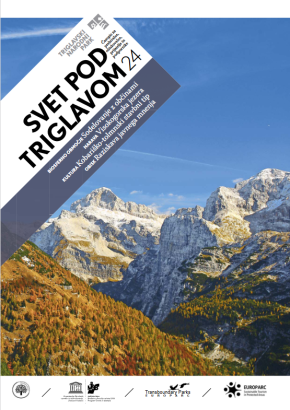
The world under Triglav (Svet pod Triglavom) (Svet pod Triglavom)
The newspaper is aimed at residents, visitors, fans and supporters. It is free for park residents and available at Triglav National Park information centres.
Up to two issues a year are published.
Source
TNP Publications, Triglavski narodni park
Year
2017
Type
Magazine
Format
Document (PDF, DOC, ...)
Keywords
Newspapers
Območja
Triglav National Park
Was this page helpful?
Thank you
Thank you.